


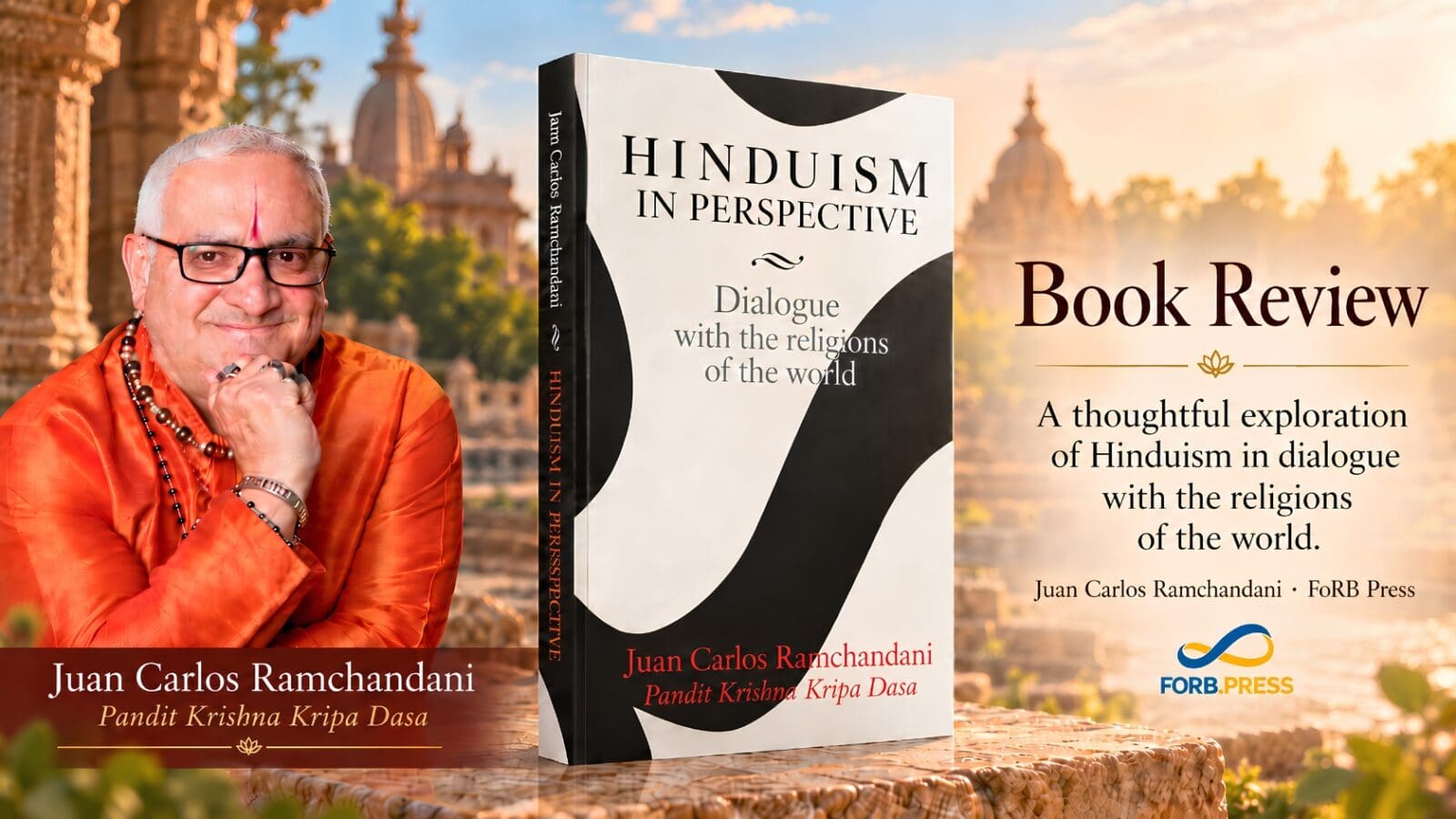
Juan Carlos Ramchandani’s new book places Hinduism in conversation with thirteen religious traditions and shows that serious interreligious dialogue does not require differences to disappear.
Books about interreligious dialogue often face a difficult choice. They can concentrate so heavily on theological differences that the religions seem destined to speak past one another, or emphasize common ground so enthusiastically that distinct beliefs begin to blur.
Hinduism in Perspective: Dialogue with the Religions of the World, by Juan Carlos Ramchandani — also known as Pandit Krishna Kripa Dasa — finds a more rewarding path between the two.
Published in English by FoRB Press in October 2026, the book begins firmly inside the Hindu tradition and then looks outward. Buddhism, Jainism, Sikhism, Confucianism, Taoism, Shinto, Judaism, Catholic Christianity, Protestant Christianity, Islam, the Bahá’í Faith, the Unification Church and Scientology all enter into conversation with Hinduism.
The result is an unusually broad but approachable work of comparative religion, written not from the detached perspective of an encyclopedia, but by a Hindu practitioner who has spent decades involved in interreligious encounters.
Ramchandani makes that perspective clear from the beginning. He does not present the book as an academic study in the strict sense, but as an open and respectful reflection arising from his experience of dialogue.
That honesty is one of the book’s strengths. The reader always knows where the author is standing.
Understanding Hinduism before comparing it
Before introducing the other religions, Ramchandani devotes the opening part of the book to Hinduism itself.
This is important because Hinduism does not fit neatly into many familiar Western assumptions about what a religion should look like. It has no single founder, no single universally authoritative institution and no single closed creed shared in precisely the same way by every school.
Ramchandani introduces Hinduism through the concept of Sanatana Dharma and explains central ideas including dharma, karma, samsara, moksha, Atman and Brahman. He discusses the Vedas, Upanishads and Bhagavad Gita, different approaches to the Divine, the major paths of yoga, ritual, sacred sound, spiritual teachers and the diversity found within Hindu practice itself.
This opening section gives readers enough vocabulary to understand the comparisons that follow without turning the book into a specialist theological manual.
It also establishes one of the ideas that will accompany the reader throughout the book: Hinduism’s comfort with plurality.
Ramchandani repeatedly returns to the Vedic expression Ekam sat viprah bahudha vadanti — “Truth is one; the sages call it by different names.”
That statement becomes the book’s starting point for encounter, but not an excuse to claim that all religions teach the same thing.
Where differences make dialogue more meaningful
Some of the most interesting pages appear precisely where apparent similarities reveal deeper distinctions.
The chapter on Buddhism is a good example. Hinduism and Buddhism share a cultural and historical world and both speak about karma, liberation, meditation, detachment and the cycle of existence.
Yet Ramchandani gives proper attention to a decisive difference: Hindu teachings about Atman and the Buddhist teaching of anatman, or the absence of a permanent self.
The comparison therefore goes beyond saying that two religions both meditate or believe in karma. It asks what each actually means by the human person and liberation.
A similar dynamic appears in the discussion of Christianity.
There is an obvious temptation to compare the Hindu concept of an avatar with the Christian Incarnation. Ramchandani recognizes the point of contact but also explains why the concepts cannot simply be treated as equivalents. Christianity’s understanding of the unique Incarnation of Christ differs fundamentally from the Hindu understanding of recurring divine manifestations.
Reincarnation and resurrection are similarly placed side by side without being confused.
Once these differences are visible, the book becomes even more interesting when it returns to areas of genuine affinity: devotional love, contemplation, mysticism, sacred music, pilgrimage, community, ritual and service to others.
Rather than weakening dialogue, theological difference gives it substance.
Hinduism and Islam across deep differences
The chapter on Islam illustrates this especially well.
Islam’s absolute monotheism and prohibition against representations of God stand in clear contrast with Hindu devotional traditions in which the Divine may be approached through numerous forms and sacred images.
The religions also differ in their understanding of revelation, prophecy, incarnation, history, resurrection and reincarnation.
Ramchandani does not try to dissolve those differences.
Instead, he looks for places where religious life itself creates bridges: prayer, fasting, charity, sacred recitation, community and the discipline of devotion.
His discussion of Sufism is particularly engaging. The relationship between spiritual teacher and disciple, the use of devotional music, remembrance of God and the language of divine love provide points of comparison with Hindu bhakti traditions without suggesting that Sufism and Hinduism are interchangeable.
That is the sort of comparison that makes the book useful.
It allows similarities to provoke curiosity rather than premature conclusions.
A wider table for interreligious dialogue
One of the most distinctive aspects of Hinduism in Perspective is the range of religions invited into the discussion.
Many comparative religion books would have stopped after Hinduism, Buddhism, Christianity, Judaism and Islam.
Ramchandani does not.
The Bahá’í Faith, the Unification Church and Scientology receive their own chapters and are approached with essentially the same structure and seriousness as the older traditions.
That decision gives the book a genuinely contemporary understanding of religious diversity.
The chapter on the Bahá’í Faith naturally discovers considerable affinity around religious plurality, human unity and the idea that divine guidance has appeared in different historical contexts. At the same time, it distinguishes the Bahá’í concept of Manifestations of God from Hindu understandings of avatars.
The Scientology chapter explores another kind of encounter, this time between an ancient religious tradition and a comparatively recent one. Ramchandani identifies areas of comparison around spiritual identity, existence beyond a single lifetime, spiritual freedom and disciplined practice while also noting substantial differences in theology, scripture, ritual and historical development.
The author is also transparent about having personally encountered Scientologists in interfaith settings and visited Saint Hill in the United Kingdom.
That kind of disclosure helps the reader understand the experience from which he writes.
Women are part of the conversation throughout
Another feature that gives the book substance is its repeated attention to women in religious life.
Rather than treating gender as a final supplementary chapter, Ramchandani asks how women are understood and participate within almost every religious comparison.
This brings goddesses and Shakti into conversation with female Buddhist monastics, Christian saints and religious orders, Jewish and Muslim traditions, Bahá’í teachings on equality and contemporary women in religious leadership.
The treatment is necessarily concise, but its consistent presence is valuable.
Religions are not only collections of doctrines. They are communities lived by men and women, transmitted through families, institutions, rituals and generations.
By keeping that human dimension visible, the book avoids becoming purely theoretical.
An ambitious and accessible comparative approach
Comparing Hinduism with thirteen different traditions in one volume is an ambitious undertaking.
No single book of this length can provide an exhaustive account of Buddhism, Islam, Christianity, Judaism or the many other traditions it covers. Each contains enormous internal diversity.
Ramchandani is generally transparent about this. In his treatment of Buddhism, for example, he explains that the comparison draws primarily on early or Theravada Buddhism rather than attempting to encompass every later Buddhist school.
Readers deeply familiar with one of the religions discussed may naturally want to add qualifications or further distinctions.
But that does not undermine the purpose of the book.
Its achievement is to make the first serious conversation possible.
Ramchandani gives readers enough information to recognize the central questions, enough similarity to understand why dialogue can happen, and enough difference to prevent that dialogue from becoming superficial.
For an introductory work, that balance is particularly effective.
The author’s experience gives the book its voice
Ramchandani’s own biography helps explain why the subject feels natural in his hands.
Born in Ceuta to an Indian Hindu father and a Spanish Catholic mother, he encountered more than one religious world from childhood.
He entered the Hindu tradition while young, travelled extensively throughout India, lived in temples and ashrams, studied Hindu philosophy and ritual, and became a Hindu priest, or purohita. He later received the title of pandit.
His public work has likewise placed him repeatedly in interreligious settings. He became the first president of the Hindu Federation of Spain and has spent many years participating in dialogue initiatives in Spain and internationally.
This background gives the book a quality that is difficult to manufacture.
Ramchandani writes as someone who expects religions not merely to be studied but to meet one another.
The other believer is not an abstraction.
From comparison to coexistence
The epilogue brings the book’s many comparisons together and makes its deeper purpose explicit.
Ramchandani writes about personal encounter, interreligious education, social cooperation, care for the planet, service, mystical experience, shared hope and what he calls historical humility — the willingness of religious traditions to recognize their own periods of intolerance or violence.
The argument is ultimately practical.
Religious dialogue is not presented as a polite exercise conducted exclusively by specialists. It is part of learning how people with very different convictions can share societies without demanding that difference disappear.
That is also where the book connects naturally with freedom of religion or belief.
Legal protections are essential, but pluralism ultimately has to be lived between actual people.
The editor’s foreword to the English edition captures this idea particularly well with a simple observation: “Prejudice thrives at a distance.”
Much of Ramchandani’s book can be understood as an attempt to reduce that distance.
A worthwhile invitation to encounter
Hinduism in Perspective succeeds because it remains accessible without making religious difference meaningless.
It offers readers a clear introduction to Hindu thought, approaches other traditions with evident respect and shows repeatedly that disagreement need not be an obstacle to encounter.
Its broad scope will make it particularly useful to readers approaching comparative religion for the first time, but there is also much here for those already involved in interreligious dialogue.
Perhaps the book’s greatest strength is that it does not ask believers to dilute their identities before meeting one another.
Hindus can remain Hindu. Christians can remain Christian. Muslims, Buddhists, Sikhs, Bahá’ís, Jews, Scientologists and others can remain committed to their own traditions.
What the book asks is something both simpler and more demanding: learn enough about the other person to encounter them as they understand themselves.
At a time when religious communities are still frequently described through labels, assumptions and inherited stereotypes, that makes Hinduism in Perspective a timely, accessible and genuinely worthwhile contribution to interreligious understanding.
It is a book that does not try to end the conversation.
It gives readers a good reason to begin one.
Hinduism in Perspective: Dialogue with the Religions of the World
Juan Carlos Ramchandani — Pandit Krishna Kripa Dasa
FoRB Press, English edition, October 2026
ISBN 978-84-12-44716-3
Available through Amazon worldwide.